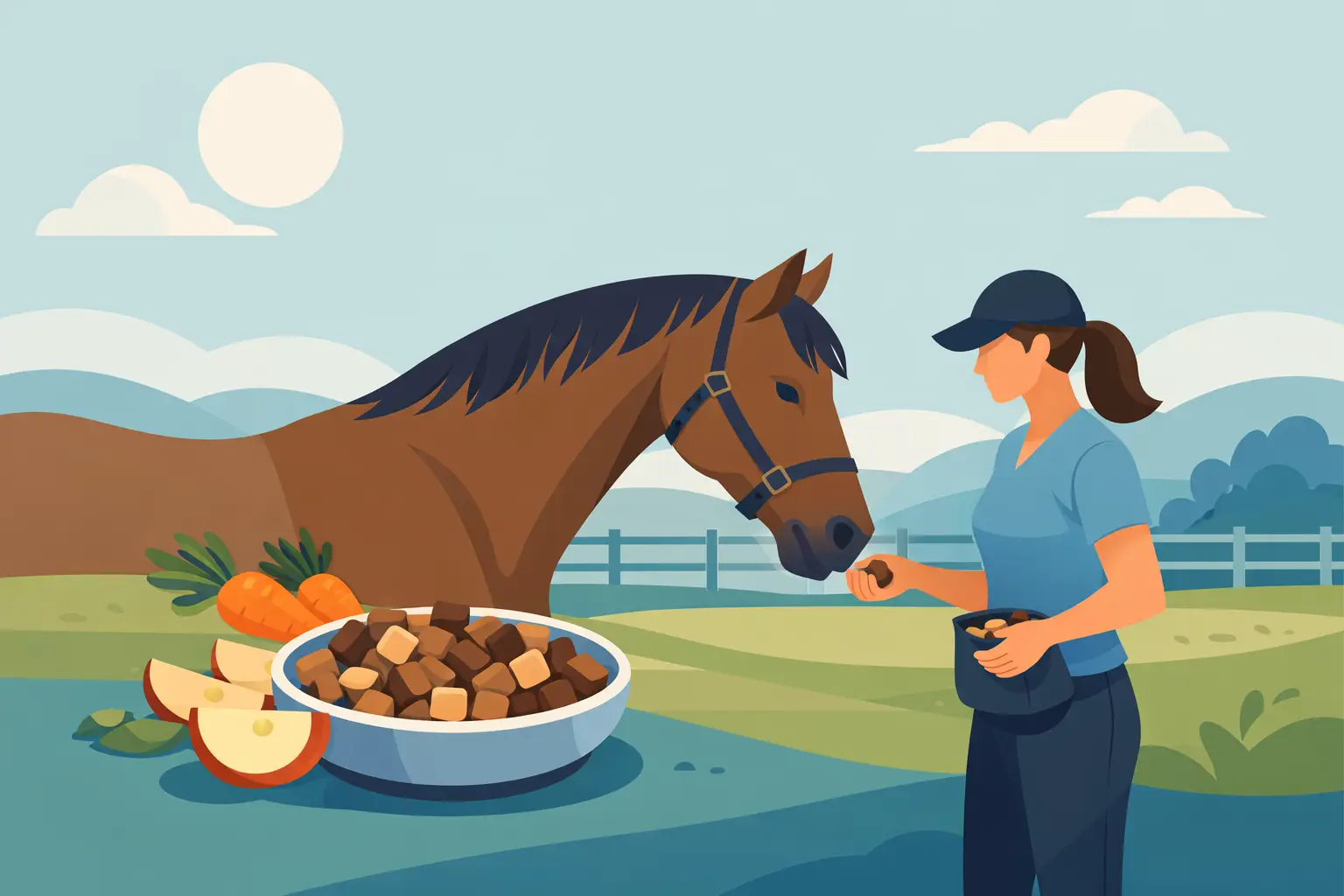
The difference between a useful reward and a distracting snack often comes down to one moment - the second your horse decides whether it was worth listening. That is why training treats for horses need more thought than simply grabbing whatever is closest in the feed room. The right treat can sharpen timing, encourage curiosity and make repetition feel worthwhile. The wrong one can create mugging, fizz, or a horse who is more interested in your pocket than your cue.
For most horses, food is a powerful reinforcer. That is hardly a revelation to anyone who has ever heard a rustle of wrappers from the far end of the yard and watched ears prick instantly. But using treats well in training is less about bribery and more about clarity. A well-timed reward tells your horse, with remarkable precision, yes, that was the answer.
What makes training treats for horses effective?
Size matters more than many owners expect. If a treat is too large, the reward interrupts the session. Your horse stops to chew, loses focus and the rhythm of the exercise goes flat. Small treats keep the reward neat and immediate, especially when you are working on repeated behaviours such as standing square, stepping over poles, lowering the head or loading calmly.
Texture matters too. Hard treats that crumble into a mess are inconvenient at best and untidy in a coat pocket at worst. Soft options can be easier to deliver quickly, but they still need enough structure to hold their shape. Ideally, a training treat should be easy to carry, simple to break if needed and appealing without becoming so exciting that your horse forgets their manners.
Palatability is another balancing act. If the reward is dull, some horses will take it politely and remain completely indifferent. If it is exceptionally rich or novel, you may end up with over-eager behaviour that undermines the training itself. The sweet spot is a treat your horse genuinely values, but not one that sends them into full detective mode every time your hand moves.
Why timing matters as much as the treat itself
A lovely treat cannot rescue poor timing. Horses learn from the consequence that comes immediately after the behaviour, not the one that arrives three strides later while you are still fumbling in your pocket. This is where many owners accidentally reward the wrong thing. A horse stands quietly, then paws, then gets the treat. From the horse's point of view, pawing worked.
Good training treats for horses support clean timing because they are ready to give, easy to handle and small enough to offer without pausing the entire session. If you are teaching something new, reward early and clearly. If you are refining an established behaviour, you can begin spacing the rewards out while keeping your praise and release consistent.
This does not mean every horse should be fed constantly through a lesson. It means the food reward should be part of a thoughtful system. A marker word, a click, or a consistent verbal cue can help bridge the split second between correct behaviour and the treat arriving. That little bit of structure keeps training tidy and fair.
The best treats are rewarding, not chaotic
There is a common fear that using food in training automatically creates pushy horses. In truth, poor boundaries create pushy horses. Treats simply reveal how clear those boundaries are.
If your horse swings their head into your space, snatches at your fingers or searches every pocket on your gilet, the answer is not necessarily to stop using food. Often, it is to teach the reward process with the same care you teach any other behaviour. Your horse can learn that the treat arrives when the head is straight, the muzzle is soft and personal space is respected.
This is one reason many experienced owners prefer more refined rewards over generic handfuls. A premium treat, given with intention, encourages precision from both horse and handler. You are not scattering snacks. You are marking success.
When to use treats, and when not to
Treats are particularly useful when you want your horse to feel optimistic about something that can otherwise become tedious, uncertain or mildly stressful. Loading practice, clipping preparation, standing for the farrier, accepting wormer, trailer confidence, injections and polite groundwork all lend themselves well to food-based reinforcement.
They are also excellent for horses who tend to switch off. A horse that finds schooling repetitive may offer more effort when the rewards are meaningful and well timed. Likewise, a nervous horse can begin to build positive associations around situations they would normally approach with tension.
That said, it depends on the horse. Some become so food-focused that simple exercises lose fluency. Others do better with a mixture of rewards - a brief pause, a scratch in a favourite spot, verbal praise and the occasional treat rather than a treat every time. If your horse starts anticipating the reward so strongly that the behaviour deteriorates, it is usually a sign to adjust your schedule, not abandon the method altogether.
Choosing ingredients with care
Horse owners who read labels closely already know that not all treats are created equally. Artificial colours, heavy fillers and long ingredient lists do not sit comfortably with many owners, especially when treats are given daily. For training, quantity can add up quickly, so ingredient quality matters.
Look for treats made with straightforward ingredients and a sensible size. Natural flavour, a pleasant aroma and a fresh finish tend to make a bigger impression than garish colour ever could. Horses often respond beautifully to treats that smell inviting and taste distinct, particularly if they are crafted with care rather than churned out to be merely shelf-stable.
This is also where luxury and practicality can meet rather nicely. A handcrafted treat does not have to be reserved for special occasions alone. When designed properly, it can turn ordinary schooling, in-hand work or medication routines into something more polished and more pleasant for horse and owner alike.
Training treats for horses and everyday manners
One of the most useful applications for treats is not flashy training at all. It is manners. Standing at the mounting block. Waiting at the stable door. Keeping a respectful distance when feed is being prepared. Lowering the head for the bridle. These are the tiny moments that shape daily life.
Because they happen so often, they are easy to overlook. Yet they are precisely the sort of behaviours that improve with immediate, consistent reinforcement. Reward the horse that waits. Reward the horse that breathes, softens and stands. Over time, those moments become habits, and the whole day runs more smoothly.
If you are working with a young horse or one who has learned to be impatient, keep the sessions brief and the criteria simple. Ask for one good response, reward it, then repeat. Precision is kinder than prolonging the exercise until both of you are irritated.
A special note on medication-friendly rewards
There is training, and then there is the practical art of persuading a horse to swallow something they would rather fling across the yard. In those moments, a treat that doubles as a medication aid is more than a luxury. It is a small act of self-preservation.
A well-designed medication-friendly treat can help maintain trust because it reduces the drama around tablets, capsules or pastes. Instead of turning treatment into a wrestling match, you can present it as something familiar and appealing. That matters, especially for horses who become suspicious after one unpleasant experience.
For many owners, this is where premium equine treats earn their place properly. A thoughtful, flavour-led treat with enough structure to conceal medication solves a real problem while still feeling like a reward rather than a compromise.
How to tell if your current treat is helping
Watch your horse, not the marketing. A suitable training treat should leave your horse attentive, interested and mannerly. They should take it readily, return to the task and stay mentally with you. If they become grabby, distracted or sluggish, something needs adjusting.
Sometimes the issue is the treat itself. Sometimes it is the frequency. Sometimes it is simply that the reward has become predictable, and the horse is focusing on the delivery rather than the exercise. Small changes can make a marked difference.
At Highland Horse Sweets, we believe rewards should feel every bit as considered as the care you give the horse you love. That means flavour with purpose, craftsmanship with function and treats that make everyday handling feel a touch more special.
The best training treats are not the flashiest or the sweetest. They are the ones that help your horse understand, stay willing and finish a session feeling quietly successful - which, for most of us, is exactly the sort of progress worth rewarding.