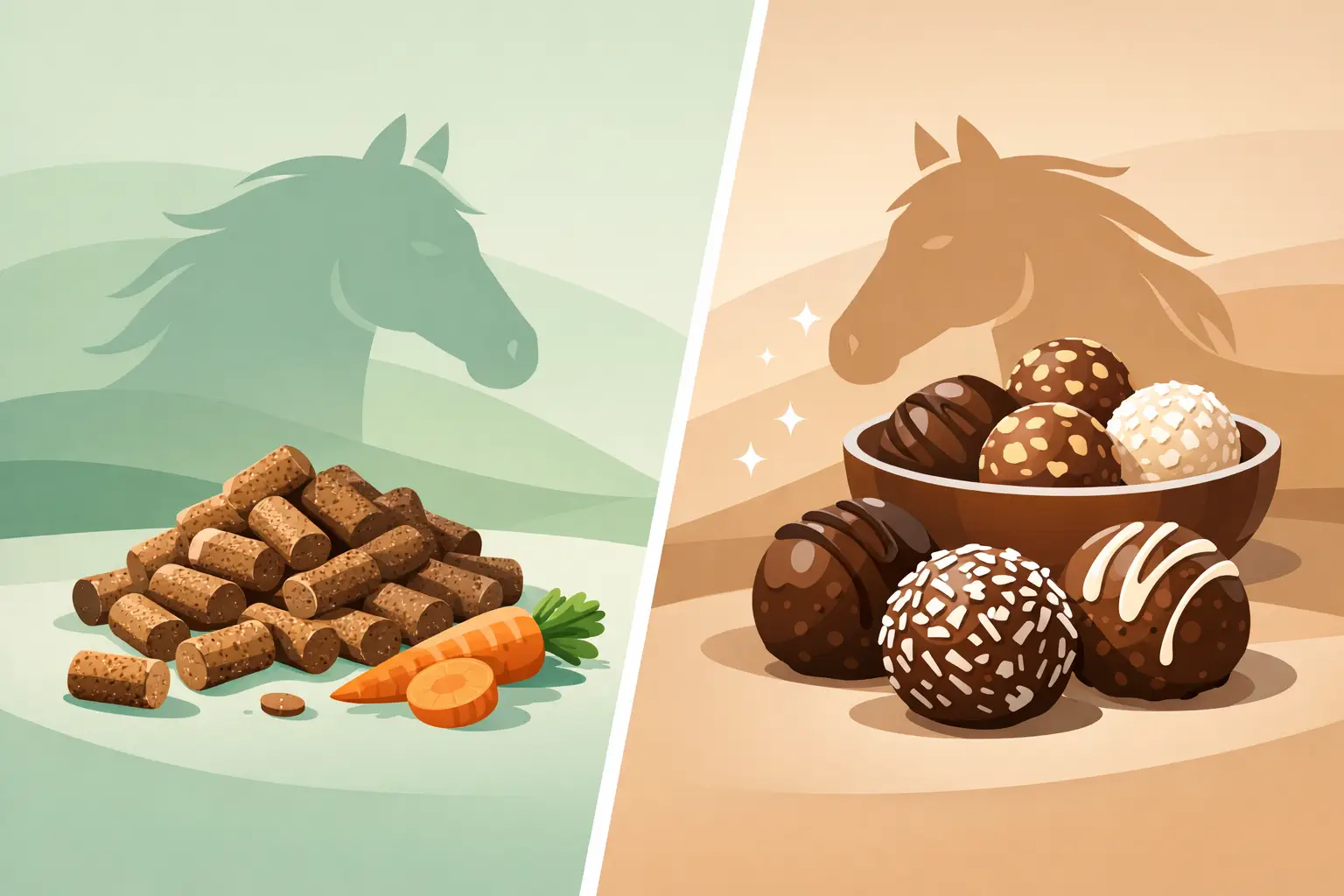
Walk into any tack room and you will usually find a tub of something reward-shaped sitting on a shelf. For many owners, the real question is not whether to give treats at all, but what sort of treat feels right for the horse in front of them. When it comes to horse treat pellets vs truffles, the difference is not simply shape or price point. It is about texture, ingredients, purpose, freshness and the kind of experience you want to create for your horse.
Some horses are perfectly content with a quick, no-fuss nibble after work. Others turn treat time into a proper ritual, ears forward, whiskers searching, clearly expecting something a little more special. That is where the comparison becomes more interesting, because pellets and truffles serve rather different roles in equine care.
Horse treat pellets vs truffles: what is the real difference?
Pellets are the familiar standard. They are usually small, dry, firm and easy to portion. They tend to be made for convenience first - tidy to store, simple to feed, and practical for everyday use in busy yards. If you want something that can be grabbed quickly during training or handed out by the handful to several horses, pellets often fit the job.
Truffles sit in a different space. Rather than being a generic reward, they feel more considered. A handcrafted truffle has texture, aroma and a sense of occasion. Instead of a uniformly dry bite, you have layers - perhaps a soft molasses shell and a flavoured centre - which changes the eating experience for the horse and the emotional experience for the owner as well.
That does not automatically make one better than the other in every situation. It simply means they answer different needs.
Why pellets became the yard staple
There is a reason pellets have been around so long. They are convenient, consistent and usually easy on the budget. For riding schools, larger yards, or owners managing several horses at once, that matters. A pellet can be popped into a pocket, measured out without fuss and used repeatedly without much mess.
Their small size can also be useful for frequent reward-based training. If you are reinforcing calm behaviour at the mounting block or rewarding a young horse for standing politely, a tiny treat given at the right moment can be more practical than a larger, richer option.
Still, convenience can come with trade-offs. Many pellet-style treats feel functional rather than thoughtful. Texture is often dry and uniform. Ingredient lists can be less appealing than owners would like, especially if you are trying to avoid artificial colours, flavours or preservatives. For horses who are fussy, older, or simply used to something more enticing, pellets can end up ignored, chewed without enthusiasm, or fed purely out of habit.
What makes truffles feel different
A truffle is not trying to be the cheapest thing in the feed room. Its appeal lies in craftsmanship, freshness and enjoyment. For owners who see treat-giving as part of bonding rather than just behaviour management, that distinction matters.
A well-made horse truffle offers more than sweetness. The texture is often softer and more inviting, the aroma more noticeable, and the flavour more layered. Horses respond to that sensory difference. You can see it in the way they search your hand, pause to savour, and remember exactly where the treat tin lives.
For many people, truffles also solve a quieter problem in the market. A lot of horse treats are designed as commodities. They do the job, but they do not feel special. A handcrafted truffle gives owners an option that matches the way they already care for the horse they love - with attention, pride and a touch of indulgence.
Ingredients matter more than many owners think
The ingredient panel is often where horse treat pellets vs truffles becomes a more revealing comparison. Not all pellets are poor quality, and not all truffles are automatically superior, but the category tendencies are different.
Pellets are more likely to prioritise shelf stability and mass production. That can mean a drier composition and a more standardised formula. Truffles, particularly those made in small batches, are more often built around freshness and ingredient character. If a product is made to order and avoids artificial additives, that can be very appealing to owners who are careful about what goes into their horse.
This is especially true for people who already scrutinise feed, supplements and forage. Once you are paying attention to the rest of the diet, it feels odd to become casual about treats. A horse may only have a few each day, but those small choices still reflect your wider standard of care.
Texture, chewing and horse preference
Horses are wonderfully individual when it comes to treats. Some like a dry, crisp bite. Others prefer a softer mouthfeel, particularly veterans, horses with dental sensitivities, or those who are naturally slower and more selective eaters.
Pellets are straightforward and often crunchy. Truffles tend to offer a softer bite and a more generous mouthfeel. That difference can affect not just enjoyment but usability. A softer treat can feel more rewarding in the hand and more appealing in colder weather when some dry treats become particularly hard.
Preference also links to motivation. If you are using treats in training, hacking, loading practice or stressful situations, a higher-value reward often gets a stronger response. Not every horse needs that. But some absolutely do.
When pellets make more sense
There are times when pellets are the sensible choice, and there is no need to pretend otherwise. If you need very frequent, low-drama rewards in a structured training session, a simple pellet may be ideal. The small size helps prevent overfeeding, and the uniform shape makes timing easy.
They can also suit larger households where several people feed treats and consistency matters. A child helping at the yard or a busy groom doing evening checks may appreciate the simplicity of a treat that is quick to portion and hard to overthink.
If your horse is not particularly food-motivated, a more luxurious treat may not make much difference. Some horses genuinely do not care. In that case, practicality wins.
When truffles earn their place
Truffles come into their own when the moment matters. After a competition, on a birthday, during clipping season, after the farrier, or simply as part of a daily ritual with a horse who means the world to you, they offer something pellets rarely do - a sense of care you can see and your horse can enjoy.
They are also especially suited to owners who want treats to feel fresh, natural and more considered. If you dislike anonymous, mass-produced snacks and prefer small-batch products with genuine character, truffles fit that preference beautifully.
There is also a practical side to premium treats that is often overlooked. A more enticing reward can improve cooperation. For some horses, that means easier catching. For others, it means a better association with loading, standing still, or accepting routine handling. A treat does not replace training, but the right one can support it very effectively.
A note on medication-friendly options
This is where the conversation shifts from indulgence to everyday usefulness. Standard pellets are rarely designed to conceal tablets, capsules or pastes. They may work if crushed or combined with feed, but that is not always tidy and certainly not always successful.
Medication-friendly treats are a category of their own, and for many owners they are a game changer. A treat designed with a soft structure or hidden centre can make the difference between a prolonged battle in the stable and a calm, straightforward routine. That matters for the horse, and it matters for the person holding the wormer.
For owners dealing with fussy horses, repeat prescriptions or regular supplements, this practical benefit can outweigh every other feature. A treat that feels special and solves a real problem is often worth far more than a basic snack that gets refused the moment medicine is involved.
Which should you choose?
The honest answer is that it depends on how you use treats and what your horse responds to. Pellets suit repetition, convenience and no-nonsense reward. Truffles suit enjoyment, ingredient-conscious buying and moments where quality is the point.
Many owners will find there is room for both. Pellets may work for quick schooling rewards, while truffles are kept for higher-value moments, visiting the yard after a difficult week, or giving a horse a little luxury simply because he deserves it. There is no rule saying every treat has to do every job.
If your priorities are freshness, natural ingredients, handcrafted quality and a more memorable experience, truffles are likely to feel far more satisfying. If your priorities are speed, quantity and everyday economy, pellets still have their place.
At Highland Horse Sweets, we believe a treat can be more than filler in a tub. For the right horse and the right owner, it can be part of the bond, part of the routine and part of making ordinary care feel a touch more special. Choose the treat that suits your horse’s needs, your standards and the small moments you want to make count.