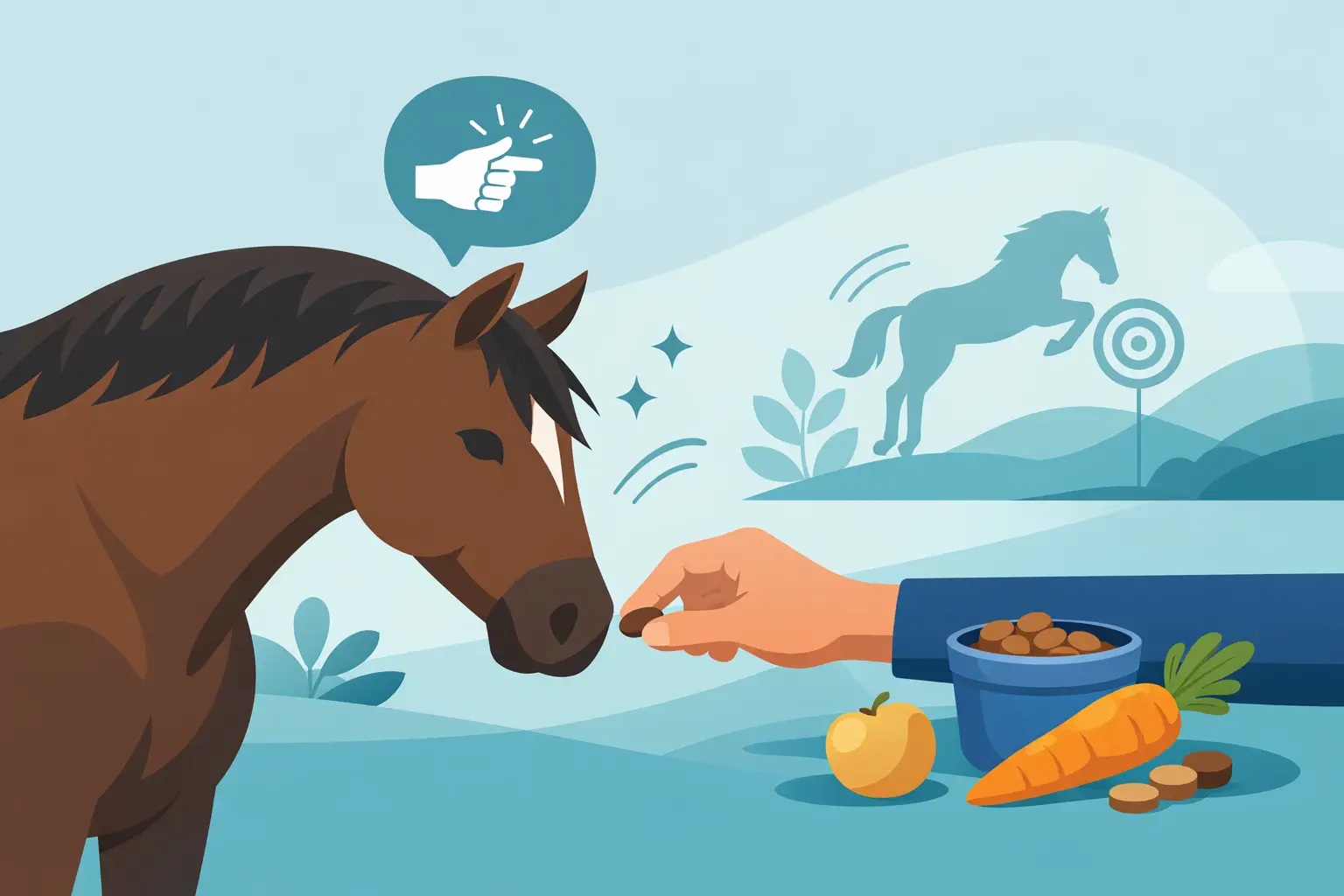
A click is wonderfully precise. It can tell your horse, within a second, that lowering their head, standing at the mounting block or taking one calm step towards the lorry was exactly right. But the click only gains meaning when it is followed by something your horse genuinely values. Choosing the right horse rewards for clicker training makes that conversation clearer, kinder and far more enjoyable for you both.
The best reward is not necessarily the biggest, sweetest or most expensive treat in the tub. It is the one your horse will work happily for, can eat quickly, and receives so consistently that the lesson stays easy to understand. For the horse you love, a beautifully made treat can turn a short training session into a small moment of shared delight. It still needs to be used with thought.
What makes a reward worth working for?
In clicker training, a reward is called a reinforcer because it makes your horse more likely to offer a behaviour again. If they touch a target, hear the click and receive a reward they enjoy, touching that target becomes worthwhile. The click marks the exact behaviour you want. The treat is the promised payment.
Horses are individuals, so reward value is never one-size-fits-all. A horse who leaves hay to investigate your pocket may find a tiny piece of carrot exceptionally motivating. Another may be unmoved by ordinary feed but light up for a soft, aromatic treat with a rich molasses finish. Watch the response rather than assuming what should be exciting.
A useful reward creates a bright, interested expression without making your horse frantic. If they begin searching every pocket, barging into your space or losing the ability to stand quietly between repetitions, the food may be too valuable for that exercise, the sessions may be moving too quickly, or your boundaries need more attention. High value is useful. Over-arousal is not.
Horse rewards for clicker training: size matters
Clicker training often involves several successful repetitions in a few minutes. That means portions matter as much as ingredients. Large treats slow the rhythm, add unnecessary calories and can make a horse linger with their head in your space rather than resetting for the next cue.
Choose treats that can be broken or offered in genuinely small pieces. Think pea-sized to thumbnail-sized for most routine work, adjusted for the size of the horse and the treat itself. The aim is a quick swallow, not a lengthy snack break. A handful of tiny rewards usually supports better learning than a few oversized ones.
This is particularly relevant when you are introducing a new skill. At first, reward generously for small tries: a glance at the target, one foot on the mat, a quiet pause beside the mounting block. Once the behaviour is understood, you can ask for a little more before clicking. You do not need to make the treat larger to make progress.
Treats should always sit within your horse’s overall ration. Natural ingredients and handcrafted quality are lovely things, but neither makes unlimited extras appropriate. For horses on restricted grazing, those prone to laminitis, or horses managing insulin dysregulation, PPID or weight concerns, speak with your vet or qualified equine nutritionist before adding food rewards. Sometimes a portion of their approved daily feed, forage-based options, or another suitable non-food reinforcer will be the better choice.
Match the reward to the moment
Not every training task deserves the same level of equine indulgence. Keeping two reward levels can make your sessions more useful.
For familiar, easy behaviours, use a lower-value reward. This may be a small piece from the horse’s normal approved feed allowance. For a new, worrying or physically demanding task, reserve something more special. Loading one calm foot into the lorry, accepting a first spray of fly repellent, or standing quietly for a clip can call for a reward that feels distinctly worth their effort.
This is not about bribery. It is about being fair. If your horse is trying something that feels uncertain, a thoughtful payment helps create a positive association. Over time, the once-difficult task can become ordinary, and you can return to a simpler reward.
Freshness also matters more than many people realise. A treat with an appealing aroma and a pleasing texture is easier for a horse to notice, especially in a busy yard or at a show. Handcrafted truffles with a molasses shell and flavourful centre can be reserved as a special reward for moments when you need real focus, while still being broken into sensible training portions.
Timing is the real magic of the click
A beautiful reward cannot repair late timing. Your click must happen at the instant your horse offers the desired behaviour, not when they have already stepped away, lifted their head or begun another movement. Practise with a simple exercise before asking for anything complicated.
For example, when teaching a head-lowering cue, decide exactly what earns the click. Perhaps it is the moment the poll drops an inch below its usual height. Click then, pause briefly, and deliver the reward. Do not wait until your horse’s nose is near the ground if that is not what they offered.
After the click, the reward should arrive promptly. You have a little more flexibility than you do with the marker itself because the click has already identified the right moment, but do not make your horse wait while you rummage through a coat pocket. Keep rewards ready in a secure pouch or small container, especially if you are working around the stable, arena or lorry park.
Use a consistent delivery position too. Many handlers feed low and slightly away from their body, helping to discourage pocket-diving and keeping the horse’s head out of their personal space. Others use a small feed bowl for exercises where hand-feeding could create confusion. The best arrangement depends on the horse, the task and your handling confidence.
Keep manners part of the training
Food can create enthusiasm, but clicker training should never ask you to tolerate crowding, nipping or pushing. Start with a simple rule: the reward arrives when your horse has their head politely away from you. If they drift into your space, wait without clicking or feeding. The instant they soften back into a respectful position, mark and reward that choice.
Short sessions are your friend. Three to five minutes of calm, clear work is often more productive than twenty minutes in which your horse becomes tired, overexcited or confused. Finish after a good repetition where possible. Then remove the treat pouch and let the session clearly end.
It also helps to train in a low-distraction place before expecting the same focus at a busy competition, on a hacking route or beside a rattling lorry. A reward that is thrilling at home may have less value where grass, friends and activity compete for attention. This is normal information, not failure. Raise the reward value, lower the difficulty, or return to an easier environment.
Choosing premium treats with a practical purpose
There is room for a little luxury in a training pocket, provided it serves the horse rather than the marketing. Look for clear ingredients, no artificial colours or flavours, and a treat texture you can portion safely. Avoid anything dusty, awkwardly hard or so large that it interrupts the pace of your training.
Highland Horse Sweets are made in small batches for horses whose owners want reward time to feel considered, not generic. Their handcrafted truffles work best as a special, high-value option: portioned thoughtfully and saved for the behaviours that take trust, bravery or real concentration.
The same principle applies to medication-friendly treats. They can make tablet time less confrontational, but they should not become an accidental training reward if your horse needs to take medicine only in a specific setting. Keep medical routines clear and predictable, and follow veterinary guidance for the medicine itself.
Let your horse have a say
When you find a reward that produces soft ears, eager attention and polite enthusiasm, you have learned something valuable about your horse. Keep that information for the days when training feels bigger than usual: the first journey after a break, the farrier visit, a new arena, or simply a lesson that asks for courage.
The click says, “Yes, that was it.” The reward tells your horse that trying was worthwhile. Offered with good timing, sensible portions and clear manners, that tiny exchange can build far more than a behaviour. It can build a horse who meets you at the gate ready to learn.